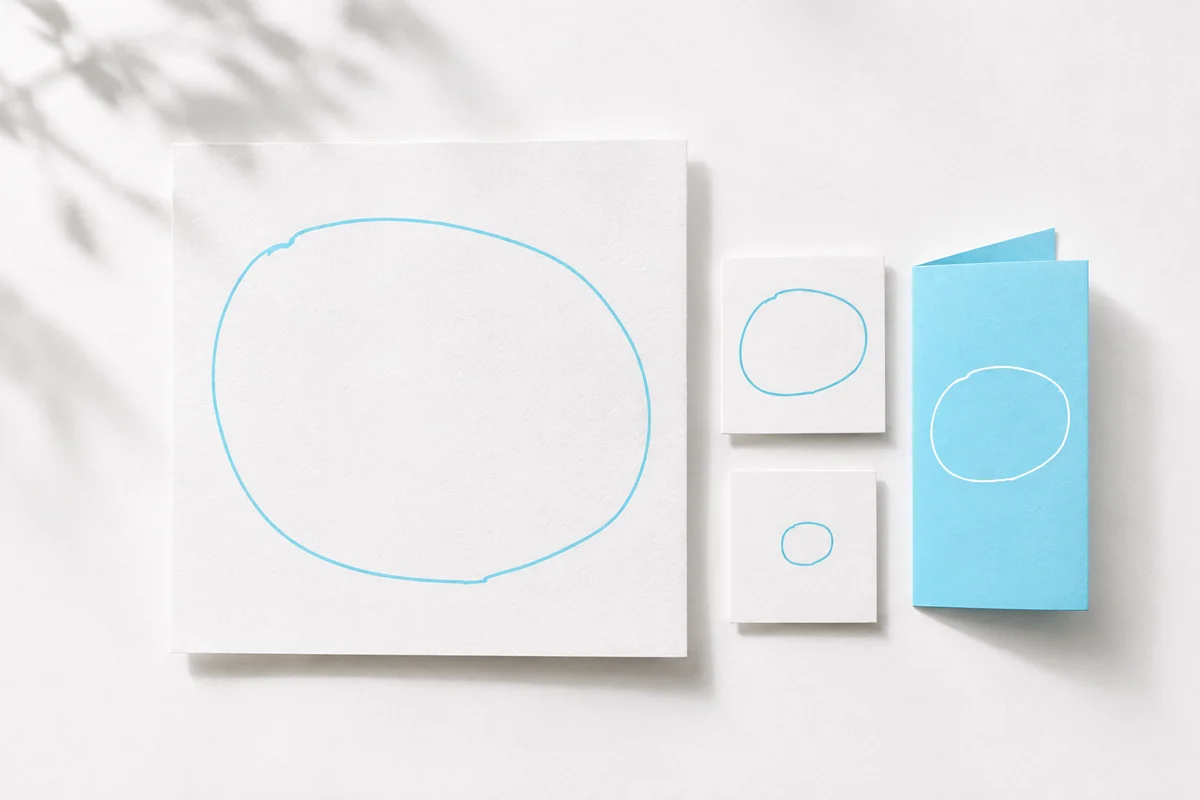
A mark can look resolved on a blank page and still leave many questions unanswered. How should a long title sit beside it? What happens when a photograph is added? Does the identity still feel familiar on a small label, a printed surface or a wide digital layout?
Moving from a mark to a complete identity means considering those relationships. Typography, imagery, colour, spacing and material do not need to compete for attention. They need a shared structure that makes their roles clear.
Work with real situations early
Choose a few applications that ask different things of the design. One might require a lot of information, another almost none. A third might depend on an unusual format. Working through those situations helps distinguish a useful decision from one that only succeeds in a single composition.
Instead of polishing every application immediately, make quick studies. Try the same content in two arrangements. Reduce the scale. Remove an illustration. These simple tests can reveal which elements carry the identity and which ones need more support.
Make space a deliberate decision
Spacing creates relationships just as colour and shape do. Consistent margins and a clear grid can connect applications without forcing them to look the same. A quiet composition and a busy one can still belong together when they share a sense of proportion.
A system should also allow a little variation. A drawing may need a more open area than a paragraph of text. A small wordmark may need a different balance from a large one. The structure should help make those decisions rather than replace judgement.
Keep the rules useful
A useful set of guidelines explains the decisions people will actually face. Show how typography behaves, how images can be cropped and which relationships should remain consistent. Examples are most helpful when they make the reasoning visible.
The identity then becomes something that can continue beyond its first presentation. New material has a place to begin, and the original character has room to grow. A complete system is not a collection of identical layouts; it is a shared language that can support many different expressions.